
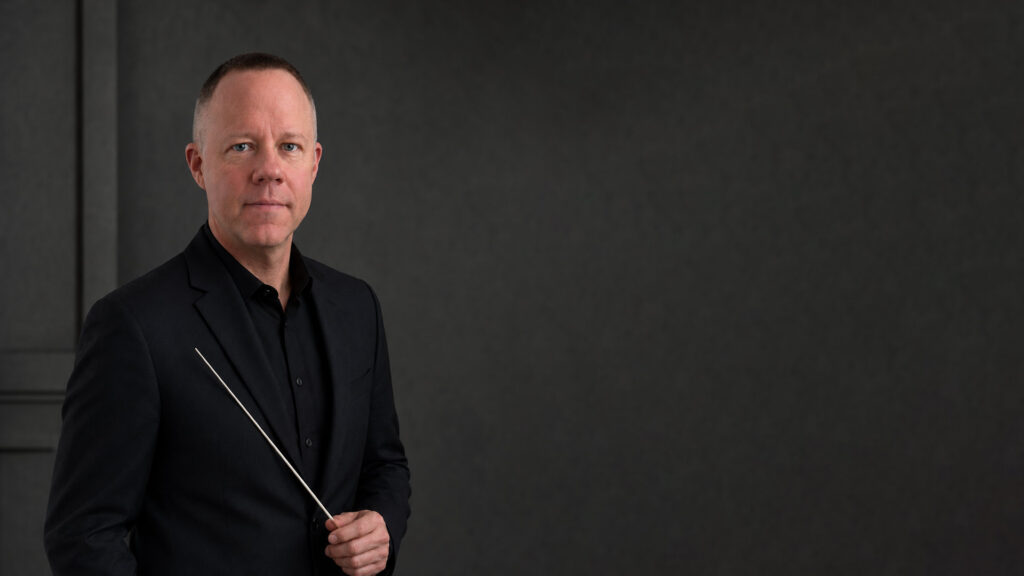
Chris Gilliam, Symphony Chorus Director
Praised for the “precision and clarity” of his conducting and hailed for his “enlightened” direction, North Carolina native Christopher Gilliam is a conductor, educator, composer, and professional singer whose career encompasses collegiate, professional, symphonic, and sacred music. He serves on the faculty of Wake Forest University, where he conducts the Chamber Choir, Lyric Concert Choir, and Schola Cantorum.
Under his direction, Wake Forest Choirs have toured throughout the United States, Brazil, Portugal, and Spain; collaborated with prominent regional arts organizations; and performed for major university occasions. In 2023, the Chamber Choir was named a national finalist for The American Prize in Choral Performance.
Since 2015, Gilliam has served as director of the Winston-Salem Symphony Chorus, preparing the ensemble for more than two dozen major choral-orchestral works and conducting several in performance. His repertoire with the chorus includes the Requiems of Verdi, Brahms, and Mozart; Mahler’s Symphony No. 2, “Resurrection”; Beethoven’s Symphony No. 9; Orff’s Carmina Burana; Dan Locklair’s Requiem; Karl Jenkins’s The Armed Man: A Mass for Peace; Craig Hella Johnson’s Considering Matthew Shepard; Elaine Hagenberg’s Illuminare; and Vytautas Miškinis’ Light Mass. In 2026, the Symphony Chorus collaborated for the first time with the Greensboro Symphony in Verdi’s Requiem and with the Piedmont Wind Symphony in James Syler’s Symphony No. 2.
Gilliam is also the founder and artistic director of Winston-Salem Choral Artists, a professional nonprofit ensemble established in 2023. Under his leadership, the ensemble has performed Bach’s Mass in B Minor, James MacMillan’s Seven Last Words from the Cross, and Eric Whitacre’s The Sacred Veil, as well as Dan Forrest’s Creation, presented in collaboration with four area high school and youth choruses. Winston-Salem Choral Artists appeared by invitation at the 2025 North Carolina American Choral Directors Association Conference and the 2026 Piccolo Spoleto Festival in Charleston, South Carolina. Forthcoming projects include Margaret Bonds’s Credo, Kodály’s Missa Brevis, Christopher Tin’s The Lost Birds, and Alex Berko’s Sacred Place.
As a guest conductor and clinician, Gilliam’s residencies have taken him most recently to Harvard University, Boston University, Marsh Chapel, the University of New Mexico, Millikin University, the University of the Bahamas, and the International Performing Arts Institute in Germany. He is also Director of Music at Highland Presbyterian Church in Winston-Salem, where he oversees an active music ministry.
Before joining Wake Forest in 2020, Gilliam held faculty appointments at Northwestern State University and Davidson College. Across these institutions, he expanded collegiate choral programs, established touring initiatives, secured philanthropic support, produced the recording Heaven Full of Stars, which was distributed nationwide, and conducted performances at Washington National Cathedral, St. Peter’s Basilica, and Oracle Arena. At Wake Forest, he collaborated with University Advancement and Wake the Arts to help secure more than $1.6 million for a permanent touring endowment supporting student performance, travel, and intercultural engagement. He also serves on the board of the North Carolina chapter of the American Choral Directors Association, co-chairs its Collegiate Choral Festival, and has served as Auditions Chair.
Gilliam’s work as a conductor is informed by extensive experience as a professional ensemble singer. Since 2018, he has performed with the Oregon Bach Festival Chorus and served on the staff of the festival’s Stangeland Family Youth Choral Academy. His additional credits include performances with Bach Charlotte, the Simon Carrington Chamber Singers, and the Minnesota Beethoven Festival Chorale under Dale Warland. He was a featured soloist on the Simon Carrington Chamber Singers’ recording Juxtapositions. Of his solo performances, critics have written, “magnificent,” “a well-modulated voice with a pleasant timbre,” “…commanding baritone,” and “…marvelous, with strikingly rich tone and impeccable diction.”
As a composer and scholar, Gilliam has published choral music with E.C. Schirmer, GIA Publications, Alliance Music, Beckenhorst Press, and Lorenz. He contributed three biographical essays to Choral Repertoire by Women Composers, published by GIA in 2025. His commissioning projects with composers Dan Locklair, Dan Forrest, Javier Farias, Thomas LaVoy, and Jennifer Stasack further reflect his commitment to expanding the choral repertoire and exploring music’s relationship to contemporary cultural and social life.
Across his professional, academic, and sacred-music appointments, Gilliam brings together adventurous programming, rigorous preparation, and a conviction that ensemble singing is both a demanding artistic discipline and a catalyst for connection, curiosity, and shared purpose, fostering a deeper recognition of our common humanity.