


An Important Audition!
In 80 years of performing for our community, the Winston-Salem Symphony has only had a handful of Concertmasters. Fewer, even, than the number of Music Directors on our podium.
As the musician who works most closely with the Music Director, the Concertmaster of the orchestra (called the “Leader” in the UK and in some other countries) is the first-chair violinist—specifically, the first-chair First Violinist, as there are two sections of violins in a standard orchestra. The Concertmaster is the last musician to take the stage, usually to applause, and signals the oboist to play the “A” to which the orchestra begins tuning. The Concertmaster is also the person who performs many of the challenging orchestral solos (think the exposed solos throughout Rimsky-Korsakov’s Scheherazade or the middle several minutes of Richard Strauss’s Ein Heldenleben), and is often featured as a concerto soloist, at least several times during their tenure. This person determines the bowing (direction and stroke of the string players’ bows) for the first violins, and often for the entire string section. The Concertmaster can often be the “face” of the orchestra in marketing materials, and is often the leader among the orchestra’s musicians in a number of different capacities. It’s a huge position with a lot of responsibility.

When longtime Concertmaster Corine Brouwer announced her retirement this past January, we knew that holding an audition for Concertmaster would be a historic event for our orchestra. We haven’t held an audition for this position in nearly thirty years.
We announced for the audition in mid-spring on our website, social media, and in various industry-specific media. Applicants needed to send a resume, list any orchestras with which they had experience, and, crucially, upload a video of themselves playing a list of required orchestral pieces, called “excerpts.” (Even in the age of AI, video is the best offer of “proof” that the candidate is actually performing, and not simply uploading a performance by someone else). Nearly thirty candidates applied. To maintain anonymity, Symphony staff pulled the audio track from these recordings and the Orchestra Personnel Manager forwarded these files individually to the Audition Committee, comprised of principal string players and a representative each from the woodwind, brass, and percussion sections.
From this pool of audio recordings, the committee chose to advance 17 candidates to the live round of auditions taking place August 31 and September 1. During this phase, the Audition Committee and Music Director Michelle Merrill are in the audience, but cannot see who is playing. A large screen blocks the front of the stage and a proctor (in this case, the Orchestra Personnel Manager) escorts the candidate onstage and announces the candidate’s number. (We even go so far as to put a rug down on stage, to avoid the sound of one’s shoes). Each candidate then plays about ten minutes of a prescribed repertoire: a bit of a concerto, then two extended orchestral solos from the standard canon, then some other excerpts. After a group of five candidates, the committee would discuss their notes on each candidate and then decide to advance them to the second round or release them with our thanks for participating.
A second blind round was held in the afternoon for several who made the cut. A different concerto was asked, with different excerpts, and in some cases candidates were asked by the Music Director to play things stylistically differently: a little softer here, maybe some notes with more point or with less vibrato. How quickly a candidate can make a requested change is very telling about their musical ability and also their flexibility to work with our orchestra’s traditions.
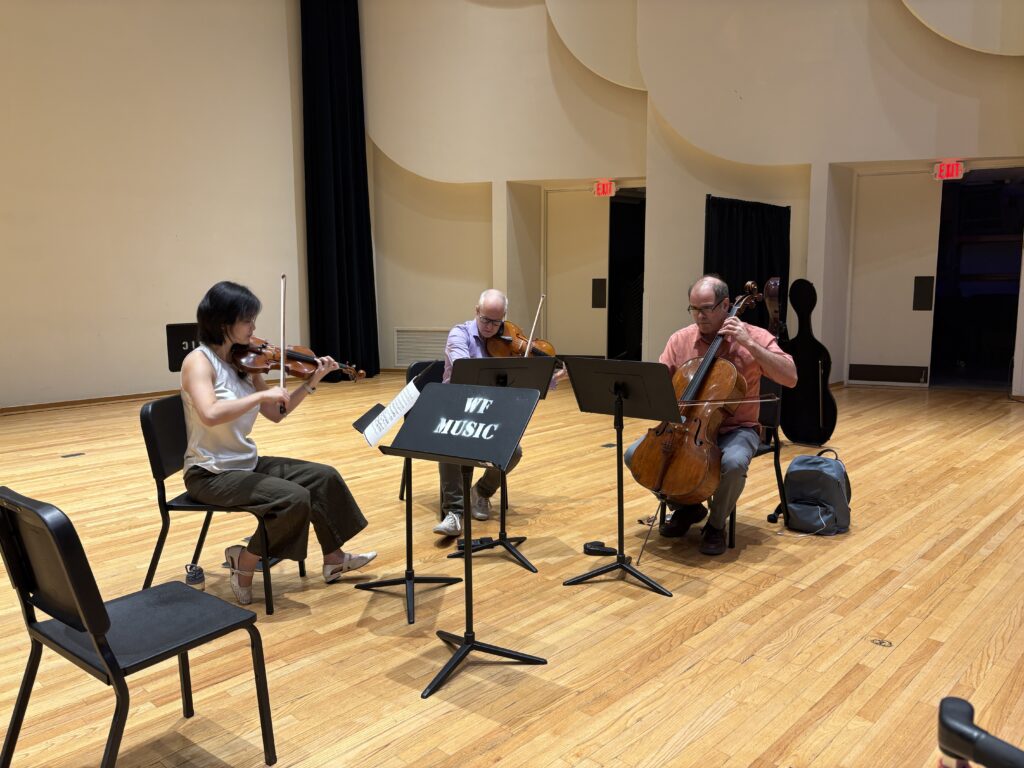
From this round, five players advanced to a Chamber Music round, where each musician played a Beethoven string quartet with principal musicians from the Symphony. This gives our principal the opportunity to work with and observe these candidates not only for musicality but also leadership qualities, and our Music Director and committee members from other sections can see how the candidates work within a rehearsal situation. After this round, the committee will again discuss, then invite two or three candidates to play trial weeks with the Symphony on Classics Series concerts during this season, while also curating and performing in chamber music concerts during those weeks. At the end of the season, we’ll be in a position to select a new Concertmaster.
It’s a long, complex, but extremely necessary process. And while it is the most layered audition process (excepting Music Director searches), we actually select all of our musicians in a similarly rigorous audition process. This is how your Winston-Salem Symphony presents the best possible music on stage, season after season.