


A Kind of Trane
Guillaume Connesson
French composer, Guillaume Connesson was born in Boulogne-Billancourt near Paris on May 5, 1970. His musical training took place at the Conservatoire National de Région de Boulogne-Billancourt and the Conservatoire National de Région de Paris. He counts among his musical influences a variety of historical and contemporary composers representing a wide range of nationalities, as well as musical styles that also embrace film and popular music. Since 2009 he has been composer-in-residence at the Orchestre de Pau, Pays de Béarn, as well as having had residences with several French orchestras, the Royal Scottish National Orchestra, and most recently with the Bern Symphony Orchestra. His Concerto for Saxophone (or Clarinet), A Kind of Trane, was composed in 2015. Its first performance took place on July 9 of that year in Strasbourg. It is scored for solo saxophone (alto and soprano), 3 flutes, 2 oboes, 2 clarinets, 2 bassoons, 2 horns, 2 trumpets, 2 trombones, timpani, percussion, piano, and strings.
A Kind of Trane is a tribute to the artistry of North Carolina-born jazz great saxophonist and composer, John Coltrane (1926-1967), who is universally recognized as one of the 20th-century’s greatest jazz innovators, and practitioners of what might be called “Free Jazz.” According to Connesson’s own notes, the first movement, “There is none other,” takes its title from a poem by Coltrane for his 1964 celebrated album, Love Supreme. As saxophonist Timothy McAllister wrote, “The piece is inspired by [Coltrane]. But it’s not a piece of jazz,” “It draws on a kind of harmonic language that he used, and some of his writing, but also what his music sought to achieve, which was something deeply spiritual and almost, in some ways, even cosmic.” “The composer seems to have drawn from bits of Coltrane’s tunes, but nothing fully realized – no direct quotes, just these snippets the composer uses for motives and to help spin up the material.” The second movement, “Ballade,” features the lyrical side of the saxophone. According to Connesson, “A second theme appears, accompanied by a regular bass the lends the character of a slow musical procession.” He describes the finale, “Coltrane on the Dance Floor,” as “an improbable meeting of two musical antipodes: the unpredictable rhythmic freedom of Coltrane and the robotic character of musical techno . . . that culminates in a crazy cadenza.”
Program Note by David B. Levy/Guillaume Connesson ©2026
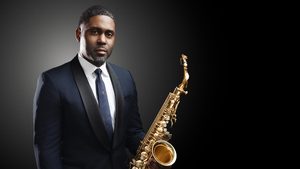
Gershwin, Rachmaninoff, & Trane
Saturday
Sep 26
7:30pm
Sunday
Sep 27
3:00pm