
Symphonic Dances, Op. 45
Sergei Rachmaninoff
Sergei Vassilevich Rachmaninoff was born in Oneg, Novgorod on March 20/April 1, 1873 and died in Beverly Hills, CA on March 28, 1943*. Famed as both pianist and composer, Rachmaninoff left Russia after the Revolution of 1917, eventually taking up residence in the United States. His Symphonic Dances was written in 1940 and marks his final composition. It received its premiere on January 3, 1941 with Eugene Ormandy conducting the Philadelphia Orchestra. The work is dedicated to these musicians. The work is scored for piccolo, 2 flutes, 2 oboes, English horn, 2 clarinets, bass clarinet, alto saxophone, 2 bassoons, contrabassoon, 4 horns, 3 trumpets, 3 trombones, tuba, timpani, triangle, tambourine, side drum, cymbals, bass drum, tamtam, xylophone, glockenspiel, tubular bells, harp, piano, and strings.
*NB: The variation of dates reflect the difference between the Julian and Gregorian calendars.
The Russian-born pianist and composer Rachmaninoff falls into the tradition of the great performer-composers of the Romantic style that began with figures such as Niccolo Paganini and Franz Liszt. Like his great predecessors when at their best, his music avoids the self-indulgent kind of virtuosity-for-its-own-sake practiced by less gifted musicians. His music often is quite sentimental, but his melodic gifts were more than sufficient to prevent it from becoming maudlin. In his Symphonic Dances, however, the composer abandoned his earlier style in favor of a leaner, more angular (dare one say modern?) idiom. Had he lived longer, who knows where this new style might have led him?
Rachmaninoff composed the Symphonic Dances while living at the Honeyman Estate in Centerport (Long Island), New York. His original title for this three-movement suite was Fantastic Dances, with movement titles of “Noon”, “Twilight”, and “Midnight”. As the title of the work implies, the composer considered this music suitable for ballet. He hoped that the famous choreographer Fokine would take an interest in it, as he had done with the Rhapsody on a Theme of Paganini for piano and orchestra, but the project never came to fruition. A simultaneously-composed version for two pianos also exists, having been performed by the composer and Vladimir Horowitz at a private party in August 1942. The orchestral version has become Rachmaninoff’s testament—a work that spans his entire life’s work.
An example of this lies in the energetic first dance, marked enigmatically Non allegro, where he quotes at the end the opening theme of his First Symphony (1897), which in turn was derived from motifs characteristic of Russian church music. There is a double sense of nostalgia here as Rachmaninoff spent much of his time after 1918 away from his native Russia. Also, his Symphony No. 1 was a failure at its first performance. An interesting feature of this movement is his prominent writing for the saxophone, an instrument that rarely was to be found in a symphony orchestra (his compatriot, Sergei Prokofiev, also used the saxophone in some of his works). Encouragement to do so came from the composer/arranger Robert Russell Bennett. The movement is in three clearly delineated sections, the middle part being lyrical, and the last part returning to the theme and mood of the opening.
After its harsh opening in the brass, the second movement (Andante con moto. Tempo di valse) morphs into a curious waltz (in 6/8 time), whose material is a transformation of ideas from the first movement. Colorful writing for the winds punctuates the brass chords, followed by a melancholic tune sung by the English horn and strings that becomes more agitated as it moves toward its conclusion. The movement is peppered with sliding chromatic scales and chord progressions that give the music a restless feeling of unease. The listener would be forgiven if Maurice Ravel’s evocative choreographic poem, La valse, comes to mind.
The final dance is alternates between two tempi (Lento assai and Allegro vivace) and depicts a struggle between Death, represented by the Western Gregorian chant from the Mass for the Dead, the Dies Irae, and Resurrection represented by a quotation from the ninth movement of Rachmaninoff’s Russian Orthodox a cappella choral work of 1915, All-night Vigil. The latter citation is marked in the score with the word “Alliluya.” The Dies irae tune was used many times in the concert repertory, including Berlioz’s Symphonie fantastique, Liszt’s Totentanz, and other examples by Rachmaninoff himself (Rhapsody on a Theme of Paganini). The text of the Russian chant reads “Blessed be the Lord” (Blagosloven yesi, Gospodi). By setting Western and Eastern chants in apposition and opposition, Rachmaninoff may be interpreted as translating the dual “citizenship” of his own career into musical terms. The composer is quoted as having stated somewhat prophetically about his Symphonic Dances, “It must have been my last spark.” That the Russian Resurrection hymn proves triumphant may also be interpreted as Rachmaninoff’s personal wish that his legacy would be redeemed, as much as a hope for his own resurrection after his death. He needn’t have worried. His music plays on.
Program Note by David B. Levy, © 2017/2025
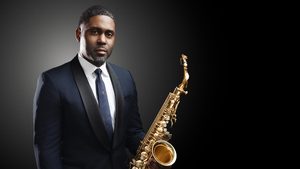
Gershwin, Rachmaninoff, & Trane
Saturday
Sep 26
7:30pm
Sunday
Sep 27
3:00pm